


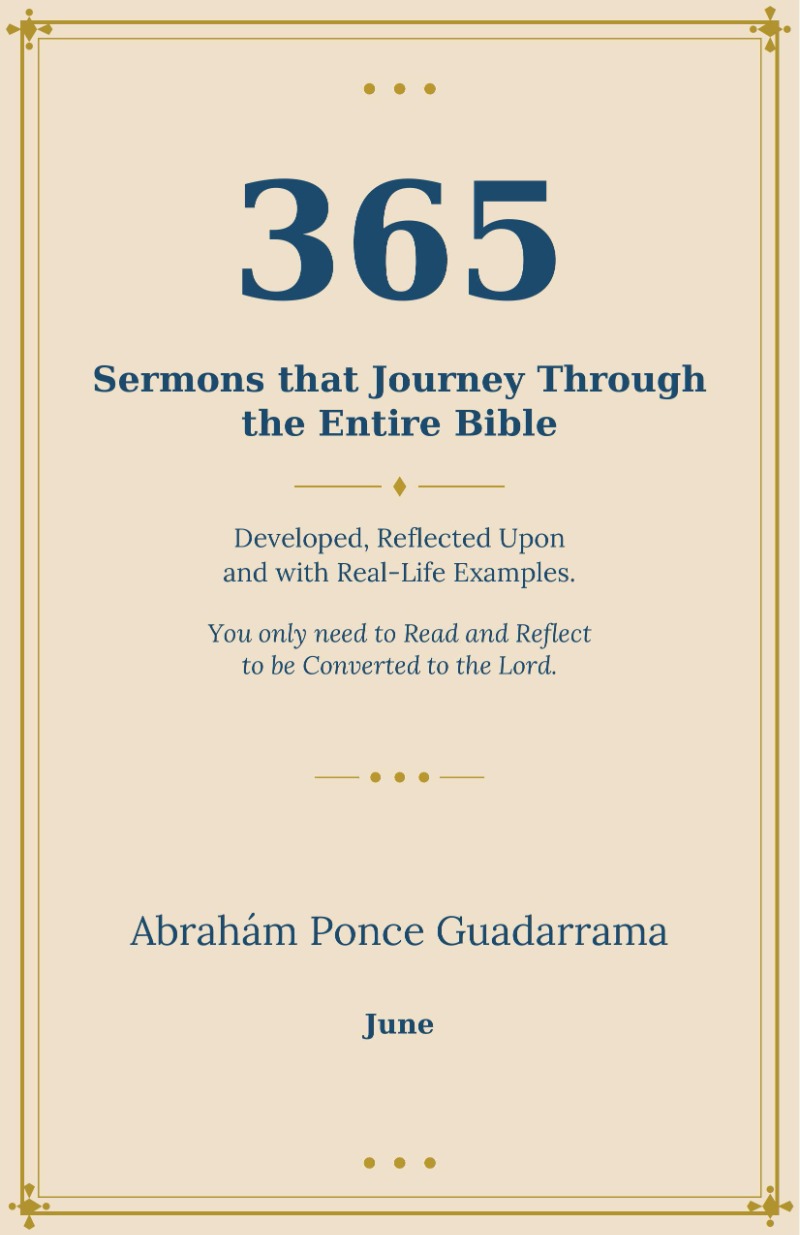
365 Sermons that Journey Through the Entire Bible
June
Editorial:Ponce Guadarrama, Abrahám
Materia:La Biblia
Público objetivo:General
Publicado:2026-07-15
Número de edición:1
Número de páginas:250
Tamaño:13.97x21.59cm.
Precio:$333
Encuadernación:Tapa blanda o rústica
Soporte:Impreso
Idioma:Inglés
Libros relacionados
A t'aane' u jaajil áantaj utia'al a maas na'atik le bibliao' - Anónimo
A t'aane' u jaajil áantaj utia'al a maas na'atik le bibliao' - Anónimo
Ajngáa' nindxuu gajkhun rí mambáyáa' matanigajmaa biblia - Anónimo
Ajngáa' nindxuu gajkhun rí mambáyáa' matanigajmaa biblia - Anónimo
Reseña
Preface
Este sexto libro mira hacia atrás para poder avanzar: recorre de
nuevo la historia del reino, esta vez desde la perspectiva del linaje
davídico y el propósito eterno de Dios detrás de cada generación.
Junio concluye 2 Reyes con la caída de Jerusalén y el exilio a
Babilonia, y recorre íntegros 1 y 2 Crónicas, que vuelven a narrar la
historia de Israel desde las genealogías hasta la restauración espiritual
bajo reyes como Ezequías y Josías, subrayando la fidelidad de Dios a
través de las generaciones y la importancia de una adoración ordenada
en el templo.
En el Nuevo Testamento, este volumen recorre el resto de 1 Timoteo,
la totalidad de 2 Timoteo, Tito y la breve carta a Filemón —las llamadas
cartas pastorales, centradas en la sana doctrina y en un liderazgo
íntegro— antes de adentrarse en la carta completa a los Hebreos, con
su magnífica presentación de Cristo como el Sumo Sacerdote perfecto,
superior a todo sacrificio antiguo, y cerrando con los primeros capítulos
de la carta de Santiago, que llama a una fe viva demostrada en obras.
El orden y la reverencia que Israel restauró en el templo terrenal
encuentran su cumplimiento en Cristo, el verdadero templo y sacerdote
eterno.
Junio invita al lector a valorar el legado espiritual que se recibe y se
transmite: así como cada generación de Israel fue responsable de
restaurar una adoración fiel, todo lector es hoy responsable de
custodiar la sana doctrina y de demostrar, con obras concretas, la fe
que profesa dentro de su propia familia y comunidad.
Vale la pena detenerse en la cantidad de detalle genealógico que
preserva Crónicas: nombres que de otro modo se habrían olvidado,
mantenidos vivos porque Dios recuerda cada generación.
Reading the Bible is not merely a personal act of faith, but also an act of integral formation that touches the lives of individuals, families, and entire societies. The history of humanity demonstrates that wherever the Word of God has been known, understood, and lived, values, justice, and hope have been strengthened. Yet it is also true that the complexity of its 66 books and more than a thousand chapters can prove challenging for many, who end up losing sight of the coherence and central message of the Scriptures.
For this reason, this work was born with a clear intention: to help people understand the Bible in an orderly, profound, and accessible way. The effort of analysis and synthesis carried out here has sought to extract the heart of each book and chapter, so that the reader may find a clear map amidst the vastness of biblical revelation. Each day, following this plan through 365 journeys, what is offered is not merely a reading guide, but also an interpretive key that facilitates understanding and opens the path to personal, family, and community edification.
As a scholar would note of a historical process, the Bible is presented here not as isolated fragments, but as a coherent narrative that gives meaning to human existence. That structured and pedagogical vision is what this work offers: a guide that by no means replaces the living experience of the text, but simply orients readers toward an orderly and edifying reading.
It has been a true honor for me to write this work. My wish is that this effort become a tool of edification: that it transform hearts, strengthen families, and renew entire societies, because where the Word dwells, life flourishes.
Abrahám Ponce Guadarrama
